Tuesday, April 28, 2009

The most famous Brazilian in Central Asia was a slave

Uzbekistan, from all places, seems to be the destination of choice of retiring Brazilian soccer stars. World champion Rivaldo plays in Buniadkor, the team from Tashkent. Zico trained the team at some point.

But even more than Ronaldo and Ronaldinho and whatever "Rs" Uzbeks can come up with, it’s the Brazilian soap opera that really connects Brazil to Central Asia. There is a facination for us, exotic Brazilians.

When I was in India a few years ago, a Tajik classmate told me she loved Brazilian films. How the hell the Brazilian cinema reach Tajikistan, I wondered. Then she said she really enjoyed Isaura. She was referring to Escrava ("Slave") Isaura, a soap opera from the seventies that for some reason was a phenomenon in the communist world. Its main actress, Lucélia Santos, who played the white slave of the title, was (and still is) greeted as a star in all the former Soviet Republics, as well as in China and Cuba. Just two weeks before my arrival in Kazakhstan, there she was as the guest of honor of the Brazilian Film Festival in Astana. In Kyrgyzstan, a tour guide told me that the time in the evening when our soap operas played was the one favored by thieves, that would enter the houses and steal their bounty while the family kept their eyes glued to the screen.

The capitals of Central Asia (and of "Planalto Central")

Almaty, Bishkek, Tashkent, Brasília. Sister cities. Low, long buildings; solid, geometric structures; long, wide avenues; parks and trees galore; far from the sea. You’ve seen one: you’ve seen all. Well, not quite so. There are always surprises.

The luxuriously designed lounges in Almaty (design furniture, international cuisine, vodka, live singers, beauties dancing on the counter). Almaty, the "garden of apples", is the former capital.

The intimate scale of the greenest of them all, Bishkek, old Frunze, that manages to keep a human feeling to what would otherwise be a typically cold and gray Soviet capital.

An austere and earnest production of Gisele (or any other ballet or opera) at the Opera Theater in Tashkent, where old and young, rich and poor, virtually anyone can buy a ticket and be surrounded by the simple and sincere beauty of the spectacle and the building.

Brasília, where, well, you will find a lot of Brazilians.


Astana and Ashgabat are rather cousins of Brasília - not sisters, with their brand new (sometimes kitch) architecture.

Astana, the capital that is farthest from the Ocean, the second coldest capital in the world, the Dubai of the steppes. Astana, the city of gleaming skyscrapers, with barely a soul on the streets. Astana, the the capital built in an effort to occupy the Far North of Kazakhstan (a region closer to Russia). Economic crisis = unfinished megadevelopments, half-built concrete mammoths. But Astana is there to stay, to be loved or hated, to be envied or despised. And to become the future home to a few Brazilian diplomats (those particularly critical of Brasília might become more appreciative of it after being "really" far from the sea and out in the cold).

Ashgabat is the odd kid on the block, much like Turkmenistan, which doesn’t quite fit in the lot of Stans of Central Asia. What to make of it? An hybrid of Singapore and Dubai, the immaculately clean city is out of tune with the much poorer rest of the country. It lives in its own dimension, and proudly so. It’s the fruit of the design of Saparmurat Niyazov, or Turkmenbashi (“father of the Turkmen”), the first president of the country, who spared no effort to build a gleaming city that was devastated by an earthquake in 1948, leaving Nyazov’s mother and two siblings dead, along with other 150.000 people. It’s the white city, where all public and main buildings are covered by white marble. One would suspect Turkmenistan might have helped keeping the Italian and the Spanish trade deficits not too out of control simply by buying all that stone. Besides the white buildings, the monuments and statues stand out. And in this domain Turkmenbashi, the president that could be king, reigns absolutely. Though dead since 2006, he lives and shines in the many golden statues in Ashgabat and elsewhere in the country, together with the statues of his mother, father and infant brothers. The main statue, atop the Arc of Neutrality, sits on a mechanism that rotates it in a way that leaves Turkmenbashi always facing the sun. Other unusual sites in Ashgabat are the “walks of health”. When Turkmenbashi decided to stop smoking, he forbade smoking on the streets and built two long paths, one with 8 km and the other with 24 km. Going up the hills, with thousands of steps, they are illuminated and can be seen from different points of the city. Although one’s health might improve after completing the shortest path a few times a year, the effects of completing the longest one are yet unknown.

The current president seems to be slowly undoing some of the more controversial policies of Turkmenbashi. He allowed the use of internet; replaced the old currency (the old bills, no matter their denomination, carried the face of the first president); and restored the old names of the months of the year, which had been renamed by Turkmenbashi with the names of his parents and relatives. Still all public buildings, universities, aeroports carry the name of the first president.

Turkmenistan was my first experience of a country that still has very visible marks of a cult of personality. It's pure travel bliss, like being transported to another time or dimension.

Central Asia's pot - and a lesson on stereotypes

One of the best aspects of traveling abroad is the possibility of overcoming prejudices and stereotypes through a first hand contact with the places and people along the way; of being surprised by how the world is richer and more complex than previously expected. I was surprised, for instance, to know that the cap on the head of my driver-cum-guide-cum-travel companion in Kyrgyzstan wasn’t a kippah, but a taqiyah. I guess I was not expecting a blond, blue-eyed, Russian-named guy in Kyrgyzstan to be a Muslim, just because I’d never seen one before. It shows not only my ignorance but also the melting pot that is Central Asia.

Well, not exactly a melting pot, but a pot where many races live more or less side by side within the same borders, and not always in great harmony. Ethnic Kazakhs make up only half of the population of Kazakhstan, as do ethnic Kyrgyz in Kyrgyzstan. Although ethnic Tajiks are registed as Uzbeks in Uzbekistan, some claim that the first outnumber the latter in the country. Ethnic Russians can be found in all countries, especially in Kazakhstan and Kyrgyzstan. Tajiks living outside Tajikistan outnumber those living in the country. In Uzbekistan, Turkmen, German, Ukrainian, Korean, Tatar, Uighur add to the mix. It’s a festival of faces and features that rival the different landscapes found in the region.

Friday, April 10, 2009

Dichotomies

The most common cliche about Istanbul must be the one on its many dichotomies. I would never pretend to know the city well, after being there only two times in a total of 10 days. But from a timid peek, one can already tell that it's a different place. Not in the "all places are different somehow" way, but in a "je ne sais quoi" way that is hard to explain. I might have been influenced by some readings, including the autobiographical piece by Orhan Pamuk, but it's not hard to realize that Istanbul doesn't easily fit in any category. The biggest cliche of them all: part-Europe, part-Asia, part-East, part-West. And the cliche stems not only from an abstraction but from the evident and unique geographical reality of the city, as one can swiftly pass from one continent to the other just by crossing the bridge on the Bosphorus.

As you walk down Istiklal Cadesi, with its 5-story buildings with ornate facades, you might have the feeling that you're in a European City. Still, it's not quite European. It is neither Asian or Middle Eastern as Damascus so evidently is. The avenues in the more affluent parts of the European side, like Beyoglu or Nisantasi, are not as orderly as in Vienna or Warsaw. Although they can be somewhat grandiose, sometimes there is also an ugliness - and the traffic jams - that is more reminiscent of Sao Paulo. Yet the overpowering energy of Sao Paulo is not there. It's easier to sense what Pamuk described as a feature of the city's people: their melancholy.

Like Buda and Pest on the Danube, the European and the Asiansides have their share of palaces built on the shores of the Bosphorus. Like Budapest, Istanbul has the magnificence of its past to show, but in the faded way of a great empire that ceased to be. Then there's the unmistakably Oriental flavor represented by the ever-present domes and minarets that dot Istanbul's skyline and make it unique in a way that no European city could be.

After talking to a few expats there, I learned Istanbul is one of these special, "love it" or "hate it" cities. This observation reminded me of Brasilia, a city that, like Istanbul, one cannot be indifferent to. Perhaps it would be more accurate to describe them as "love it and hate it". Yet, Istanbul is worlds apart from Brasília, not only for the richness of its history as for the apparently spontaneous urban development that one can't find in the planned and controled Brasília's layout.

Another dichotomy I could feel in Istanbul lay in the Turkish themselves. Eventhough they are very welcoming and friendly, they are quite reserved. Maybe traces of the melancholy Pamuk described?

All in all, its beauty and its ugliness living side by side, Istanbul is a magnetic, magnificent place to be.

Tuesday, March 10, 2009

Middle East again


Something keeps me coming back to the Middle East. I still didn't reflect upon it. I usually prefer to wait and let things sit or sink and then try to understand them emotionally rather than rationally. But let's stop the autopsychoanalysis!

There's something in the Middle East that really appeals to me. Many things, to say the truth. But these many things are easy to conjure: the delicious (and very inexpensive) food; people's hospitality; amazing historic and natural sights; people's good looks (uhmmm, is this a reason to travel? - as michelin guide raters would say, is it good in this category, is it excellent and worth a detour, or is it exceptional and worth the journey?) Here i come quibbling again.

But the explanation is in the "something".
Is it the thin line between openness and conservatism? Or between wealth and indigence? Is it just the appeal of a culture that is strange and familiar at the same time? Is it the magic that permeates the streets and houses, century-old places and customs, the aura that emanates from the cradle of our civilization and all the honey and blood spilled on so much sacred earth? Is it something in the way that people look at you that's both shy and curious, welcoming and suspicious, innocent and guilty?

Of course all these are somewhat romanticized blanket statements that don't do justice to all the different peoples and cultures and landscapes in the Middle East. Up to what point is Islam such a unifying force in that region? Islam itself has its divisions and contradictory messages. Some countries are much richer than others. Interestingly (or perhaps consequentially) countries that were not blessed with deep and vast oil wells seem to be the most beautiful. Like parties, poor people's ones usually more entertaining than rich people's feasts.

And talking about feasts, then there is the food! From the ubiquitous shawarma to the more elaborate stews and skewers. Some spices so familiar to me. Yet always some new discovery.

For a Brazilian like me, the Middle East is not an "in your face" different world like India or Southeast Asia. But it's neither an "oh, it's just the same" old boring Euroamerican environment. Maybe it's in the shades of grey. The appeal is perhaps in the mystery, in the rugged beauty that does not show itself effortlessly. Perhaps one must deserve it, in order to be allowed to comprehend the beauty of the place. I'm not talking about the superficial, easy to acknowledge beauty, but that one that reveals itself slowly, that demands you to lift the veil. This slow discovery has been worth so far. Every trip makes me thirstier. I can't answer. And I'll probably keep going for more.

Saturday, April 19, 2008

Short Indian Dialogues

(1) 
- Hello, Sir.
- Hello.
- Are you Indian, Sir?
- No. 
- You look like Indian, Sir.
- Oh, I'm trying to. But tell me.
- Yes, Sir?
- Why did you start talking to me in English and not in Hindi and called me Sir?
- Uhmmm... (then he looks kind of lost, mutter a few words and disappears as soon as he realizes I'll not buy anything or follow him anywhere). 

(2)
- Hello, Sir.
- Hi.
- Are you Indian, Sir?
- Nope.
- Where are you from, Sir?
- I'm from Brazil. 
- B...?
- Brrrrazil.
- Oh, Ronaldo. 
- Yes, that's it. 
- You like cricket, Sir?
- Oh, yes, sure. But I don't understand the game very well.
- Uhmmm (followed by a stare that betrays his thinking that I must be from another planet)

(3)
- Hello, Sir.
- Hello.
- Where are you from, Sir?
- I'm from Brazil. 
- B... Where, Sir?
- Brrrrazil. 
- How you like India, Sir?
- I like it a lot. I'm almost becoming Indian myself. 
- Oh, thank you, Sir, thank you (followed by that typical Indian smile: blindingly white, sort of childish and undoubtedly sincere) 

Monday, April 14, 2008

More on flying - and falling


This site deserves a peek for its amazing videos of harsh landings on the world't most dangerous airports:
 http://www.otbeach.com/news/airlines-and-airports--1/top-10-most-dangerous-aircraft-l
andings-in-the-world--418.html

I haven't been in such a flight or really bad turbulence but it really looks fun. I guess I could call my bungee jump in Victoria Falls in June 2006 a flight though. No fuselage, just a rope attaching my ankles and a couple of seconds in free fall.

It's difficult to explain what I felt. I was in a Conference in Zambia, held at Sun Hotel in Livingstone, a walking distance to the Victoria Falls Park. It was also possible to visit the Zimbabwean side of the falls, crossing the border on foot. They have this bungee jump platform on a bridge over a stream beside the Falls. It's the second highest jump of this kind in the world, at 108 m from the river. And it would be my first try.

It was the day after the Conference ended and the organizers would have a bus take us from the hotel to the airport after lunch. If I really wanted to jump, I'd have to be among the first in line so as to have time to come back to the hotel and 
board the bus. I wake up early, walk to the bridge, a slight headache that got stronger as close as I got to the spot, questioning myself if I'd have the guts to jump. I arrive, pay the fee, watch a video with instructions and information, sign a form releasing the company of responsability if I died or suffered injury, go to the platform, my blood pressure falls, a towel and a rope are attached to my ankles and waistline, I start sweating, a line forms behind me for the jump, a dilemma becomes unbearable: if I don't jump, I'll feel so embarassed, such a coward, that I'll never forgive myself; but I apparently can't muster the courage and bring my body to obey me. I approach the tip of the platform, feel the wind and the emptiness that surround me. I can't resist doing what I should not: looking down. Then I tell the guy responsible for the jump:
- I can't do it. I can't.
- Yes, of course you can, he replies.
- No, I can't.
- Oh, c'mon, you can.
- Ok, but you'll have to push me.
- Ok, I'll count to 5 and push you. 1... 2... 3...

And he pushes me. It was such a gentle push but enough to make me lose ground. I not only was caught by surprise, I obviously had no strength left in my legs. Absolute despair (see the picture). And then one of the weirdest sensations invades me: the certainty of death. I remember thinking that all was gone and nothing else was important. I thought of my mother. I guess I didn't have time for my whole life story, things done, things not accomplished, to flash before my eyes. I also felt a deep sense of freedom, of liberation perhaps. Until I reach the bottom point and get pushed up to the half of the height by the rope's tension and realize I could still enjoy the rest of my jump, dropping 3 more times and I could still enjoy life. And then as soon as I'm lifted 
back to the platform, I feel this urge to jump again. Unfortunately I had to rush back to the hotel.

Time has passed and I probably lost a lot of the courage I 
mustered just after the jump. But I still look forward for the highest jump worldwide, which happens to be, at 216 m, twice as high (that's Bloukrans Bridge, in South Africa)

By the way, I'd highly recommend visiting Victoria Falls and staying for a few days in one of the hotels in the vicinity. Besides the sheer size and wonder of the Falls and the surrounding forest, the view of River Zambezi at sunset, as elephants and other animals cross it, and an orange light pervades the sky before a quasi-total black sets in, are well worth the trip. Even more so if you happen to be in the hotel's restaurant, facing the river and sipping wine while this nature wonder unfolds.

more on restless travelling (this for the Portuguese speaking readers)

Este poema foi deixado pela Verinha, minha irmãzinha adotada, em um dos comentários. Mas merece ser trazido à página principal:

(Viajar! Perder países!)
de Fernando Pessoa

Viajar! Perder países!
Ser outro constantemente,
Por a alma não ter raízes
De viver de ver somente!

Não pertencer nem a mim!
Ir em frente, ir a seguir
A ausência de ter um fim,
E a ânsia de o conseguir!

Viajar assim é viagem
Mas faço-o sem ter de meu
Mais que o sonho da passagem.
O resto é só terra e céu.

Air travel paradise

A lot is said and written about the nightmare air travel has become. I had my share of delays, tough and tiring layovers, even some lost pieces of luggage. I had a 36-hour flight in a military airplane, making 6 stops along the way to the other side of the world and barely having more than 2 hours for some light sleep between one and another stop.

But I'd rather recall a nice experience I once had flying Lufthansa from São Paulo to Frankfurt. I was in the line in the airport preparing myself psychologically for a 12-hour trip, that would be followed by some hours in the airport and another long trip to Adis Abeba. Then I ask the attendant at the ckeck-in counter if I could use my miles from Varig's mileage program for an upgrade in the Lufthansa flight. It wasn't possible, but looking at the deepest disappointment and misery I couldn't disguise, I was given a courtesy upgrade to Business class. If there's one thing I don't like about travelling in business class is the fact that I'll eventually have to come back to flying coach. But once I'm there, I take full advantage of the pampering the attendants lavish on this class of people to which I'm temporarily allowed to belong to, these special people who soar above the mere mortal ones who are in the cramped seats conveniently hidden behind curtains in the other end of the aircraft.

So I'm there, sipping my fair share of Krug champagne before dinner is served. During the dinner proper, a lesser champagne is offered. I call the flight attendant and ask her if they still had the Krug. They did and she served me more of that nectar. After a good meal, and almost ready for a nap fueled with what that great fermentation process can do to those wonderful grapes of that incomparable terroir, comes the flight attendant and asks me if I had some room left in my carry-on bag. Yes, I think so, I reply. She leaves for some seconds and then returns with a closed bottle of Krug, saying: "this is for you, as I see you like it". I couldn't care less that it was obvious I considered champagne one of the best substances ever created by mankind. I thankfully accepted and almost kissed her right then and there.

(At this point, I'd better say that I'm not a wino, I just happen to love the bubbly).

If there was ever something beyond question in my mind, it was the fact that I would try and fly Lufthansa again as soon as the opportunity came. And it did. I had arrived early in São Paulo coming from Brasília. I timed the moment to go to the check-in counter carefully, so that it wouldn't be so early that they could say they would still try to sell available business class seats before granting any upgrades; or too late so they would have the excuse that the catering for business class was closed and they didn't have extra meals for that class. I arrive at the counter just to find out the flight was booked and if I had delayed a little bit more, even my coach seat might be at risk due to overbooking. Will I ever find another German blue angel who guesses my each and every wishes? But perhaps it's better this way. After all, a repeated experience, ceasing to be unique, loses much of its appeal in the memory (and is less interesting to tell).

Restless travel style and Wanda's help


Something quite difficult when I consider travelling abroad is to find a friend: (1) interested in going to the same place I want to go; (2) available to travel in the same period I am free. In one of the few times these conditions were in place, I spent a great three weeks on the beach near Salvador and Praia do Forte and in Jericoacoara. A lot of time just chilling out, sunbathing, drinking caipirinhas, unaware of good or bad news, no TV, no newspapers, limited time over the cell phone. A short spell in a small version of paradise and not as boring as heaven probably is.

But travelling alone, and the world being so big, I leave no time for contemplation. I'm constantly on the move, trying to see as much as I can in as little time as possible. It's a 
travelling style (a friend called it Japanese tourist style) that doesn't befit everyone. But being as energetic as I am, walking 8 or 10 hours a day or taking 5 or 6 different means of transport in 16 hours is part of the fun. The main drawback, besides having to carry my backpack for long hours in a row, is the overload of experiences and information, which I am only able to digest completely a few weeks after the trip's end.

An ambitious itinerary coupled with a tight schedule means a lot of time on the road, and, in the Balkans, it meant more time in buses, trains and cars than actually strolling streets and sightseeing. It is not as bad as it may look like. I read a lot of those interesting, deep - and long - "The New Yorker" articles, I finished a book, I made friends with locals who showed me their cities, I enjoyed the scenery and I even rested a little. Sometimes I made several stops along the way, frantically visiting 3 or 4 different attractions in one day. Two samples from my travelling schedule in the Balkans:

March, 23, 2008 - Sunday - objective: leave Bucharest to Brasov and see 3 castles and fortresses - these are approximate times:
5:30 am - wake up;
6:00 am - taxi to train station;
7:00 am - train to Brasov;
8:30 am - stop at Sinaia for a visit to Peles Castle;
11:00 am - back to the train to Brasov;
12:00 pm - arrival at Brasov's train station; local bus to bus station (it's always fun to try and find out how to use the local public transport, beginning by finding someone who speaks English and gives you information on what bus to take, where to buy the ticket and where to get off);
1:00 pm - bus to Bran;
1:30 pm - visit Bran castle (allegedly but mistakenly regarded as Dracula's castle);
3:30 pm - bus to Rasnov castle/fortress;
4:00 pm - visit Rasnov;
6:00 pm - taxi to Brasov;
6:20 pm - another taxi to Brasov's city center;
6:30 pm - look for and check in a hotel (leave the backpack that was hurting my shoulders after climbing all these hillocks and castles); shower and rest;
8:30 pm - visit Brasov old city; dinner;
11:30 pm - back to hotel and sleep.

March 29, 2008, Saturday - objective: seeing Rila Monastery and proceed to Macedonia:
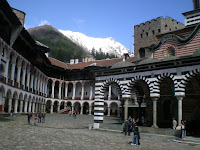
7:30 am - wake up;
8:15 am - taxi to bus station;
8:30 am - bus to Blagoevgrad;
11:00 am - bus to Rila;
12:40 pm - bus to Rila Monastery;
1:20 pm - visit Rila;
5:00 pm - bus back to Rila;
5:40 pm - hired private car back to Blagoevgrad;
6:20 pm - bus to Kiustendil;
8:15 pm - bus to Skopje/Macedonia;
12:20 am - arrival in Skopje; check-in at the hotel

It would have been impossible to visit the impressive Rila monastery, nestled in the mountains close to Sofia, in just one day unless I had booked a group tour (which I hadn't) or relied on a Bulgarian friend (which I fortunately could). Upon arriving in Rila, we found out that the bus times to and from the city would either make it impossible to visit the monastery or to come back in time for the bus back to Blagoevgrad and from there to Kiustendil in time to catch the en-route bus to Skopje.
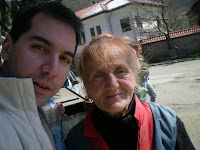
But I had a friend with me who managed, with the aid of the cleaning lady of the tiny bus station at Rila, to find a way out. She managed to arrange us a private car so that I could be in time for my bus in Blagoevgrad. Wanda was so nice! She didn't accept any sort of compensation. Well, to be true, she asked for something: that we sent her a letter, which would be a change in her rather uneventful routine in the small city.

Wednesday, April 9, 2008

Random meetings

This one happened in August last year, on a train between Cracow and Warsaw, in Poland.

I ask this girl about a magazine lying on the bench in the train cabin. I ask in English and she replies in English. A conversation ensues. Upon learning I was Brazilian, she asks if I knew Elizabeth Bishop, the American poet who lived for many years in Rio de Janeiro. I not only knew her; she was the author of one of my favorite poems, which I said to her astonishment. She was a poet herself, who lived in New England and was in Poland visiting her folks. Since then we had the opportunity to meet twice in NY.

So when someone points out that travelling alone must be dead boring, I have to say that I am sure to meet interesting people along the way, something that perhaps wouldn't happen weren't I alone.

The poem, by the way, is "One Art":

The art of losing isn't hard to master;
so many things seem filled with the intent
to be lost that their loss is no disaster.

Lose something every day. Accept the fluster
of lost door keys, the hour badly spent.
The art of losing isn't hard to master.

Then practice losing farther, losing faster:
places, and names, and where it was you meant
to travel. None of these will bring disaster.

I lost my mother's watch. And look! my last, or
next-to-last, of three loved houses went.
The art of losing isn't hard to master.

I lost two cities, lovely ones. And, vaster,
some realms I owned, two rivers, a continent.
I miss them, but it wasn't a disaster.

Even losing you (the joking voice, a gesture
I love) I shan't have lied. It's evident
the art of losing's not too hard to master
though it may look like (Write it!) like disaster.

Balkan travels (2) - More border stories

- Please open your bag. Yes.
- What are these bars, chocolate? Yes.
- Please, open one. Yes.
- Where are you going to? Macedonia.
- What for? Tourism.
- There's nothing to see there.

That's what the Bulgarian border officer said after checking thoroughly what was inside my backpack. Every passenger had to leave the bus with its bags. The bus was searched and all the bags put on a table and opened. It's interesting to notice that I was not entering Bulgaria. I was leaving it.

After arriving in Skopje, I wondered why the Bulgarian guy was so harsh on Macedonia. The city looked clean and organized, the road that took me to Ohrid was very good. And Ohrid itself looked like a piece of Côte d'Azur minus the celebrities and luxury cars. The beautiful scenery and people, good bars, food and wine are there. I recommend visiting the place before it loses its charming naiveté and becomes part of the expensive and crowded circuit of summer Festivals. I can imagine a fancy boat taking Nicole Kidman and the like for a ride to the Albanian side in the afternoon before they announce the winners of whatever festival (Lake Ohrid is in the border between Macedonia and Albania).

As a friend remarked a day later, everyone needs some else to look down on. The Romanian taxi driver in Sibiu, upon learning that I would head to Bulgaria a day later, told me to be careful because Bulgarians were thieves. He looked at me strangely when I told him I had good friends in Bulgaria and was sure I'd have a great time there. In Ohrid, a Macedonian guy of Albanian origin questioned why on earth I would go to Albania. I read somewhere that Albania is one of the countries that suffers most of a misperception about thievery. I spent less than 2 days in the country but never felt unsafe. Tirana, by the way, had a surprising lively nightlife for a Monday. Plenty of nice bars. (It also has its Apple and its Bang & Olufsen authorized dealers). And would I ever have guessed I would hear Vanessa da Mata's "Não me Deixe Só" in a bar in Tirana?


A second border story, this one at JFK in NY:
after checking my passport and my visa, the officer at the passport control comes with this:
- What's the purpose of your visit?
- I'm returning home, I reply.
He looks at my visa and says:
- You're returning to your job!


Tuesday, April 8, 2008

Balkan travels (1) - The Day I was Stopped at the Border - and Sent Back


When I was a teen in my hometown, an average-size city in the State of São Paulo, it was common for people around my age to try and spend one or two years abroad and return back to the old life in that industrial, moderately crazy town. Favored destinations were the US, the UK and Australia, where one could improve his English and be exposed to a somewhat different life style in a developed country. People would go, work as a waiter or some other job and come back. One concern was getting a tourist visa, which was easier if your parents were well-off but not a sure thing. I considered this sort of short-term migration myself but never did it.

Visa issues ceased to exist when I became a diplomat. Now even for personal travels, I could use my diplomatic passport and get a visa, if needed, in a easier and quicker way. So I was astonished that, from all places, and after visiting around 60 countries, I was denied entry, from all places and for the first time, to Moldova.

Of course, I am aware that this split personality issue (Diplomat-Backpack traveller) is not always an easy one for people to grasp, though my experience so far had been of a beneficial relationship for both.

I was in Northern Romania, where I spent 1 day visiting the painted monasteries in Bucovina (World Heritage sites worth a visit both for the architectural and spiritual aspects and the natural scenery). It was close to Moldova, a 6-hour drive by Maxi-taxi (a minivan) from Suceava to Chisinau. After waking up and managing to board the minivan that had already started leaving the Station, there I was, in my way to spend a few hours in Moldova's capital before boarding a train to Bucharest and then proceed to my next destination: Bulgaria.

At the border, the bus stops and all passports are taken to the border police.

They look at this travel document belonging to this exotic animal, most probably unheard of in the Romanian-Moldovan border: a Brazilian diplomat coming by bus.

After some 30-40 minutes, the bus driver decides to leave, saying that another bus would soon pass the border. Other passengers didn't show signs of distress at the long wait - of course and fortunately I couldn't understand what they said.

The border police was waiting for a confirmation on the actual need of a visa in a Brazilian diplomatic passport. At this point, I must observe that according to information I had obtained in my Foreign Ministry's website, that visa was not needed.

In the whole border post, only a young officer from the Customs knew some English and tried his best to be my interpreter. He looked thrilled in his new position, one that none of his superiors or colleagues could take up. He also enjoyed the possibility of brushing up his English. And he couldn't resist having foreign ears to hear how life in Moldova was difficult for the young, due to a lack of opportunities and better pay, as well as a tight, Communist-style control almost everywhere. He looked pretty authentic and, although financial issues made their way into the conversation, no hint of a bribe was made. Other people from the Customs approached to say the issue was not their responsibility: they were only the Customs and the border police were the tough guys.

Then, I'm taken to the office of the big boss, where I realized all the pages of my passport were scanned in this modern facility. I should have asked for a copy. I am subjected to an interview:

- What is the purpose of your trip? Tourism.

- Where are you staying in Moldova? I'm not staying. I'll spend only a couple of hours before boarding a train back to Bucharest.

- Did you already buy the tickets? No.

- At what time does the train leave? At 5:10 pm.

- How do you know? I checked the information on the internet and at the train station in Romania.

- Are you allowed to travel for tourism using a diplomatic passport? Yes.

- Are you carrying a regular passport? No.

- Where are you living? Where do you work? In the US, at Brazil's Mission to the UN. Can you prove? Yes, here are some documents.

And then, this pearl:
- With all due respect, is this passport authentic or false? Of course it is authentic, as well as all the visas and stamps you can see.

(The official pointed out it was strange that my photo was glued instead of printed on the page. He was obviously used to more modern documents than the older model I was carrying).

And then:

- I'm sorry, but a visa is needed and I can not let you in.

My young interpreter looked really sad, more sorry than I was.

At this point, in the split of a second, I considered switching from the backpacker mode to the diplomat in a tough negotiating situation mode and come with a discourse like: Brazil enjoys peaceful relationships all over the world, including with Moldova. After 60 countries, this was the first time I'm not allowed entry. People in my Ministry and in the United Nations will know that a Brazilian diplomat was not welcome in Moldova and, worse of all, his status and passport were considered a fake. But I also considered that the 3-4 hours I'd spend exploring the charms of Chisinau was at that point reduced to no more than 1 1/2 hour; another visa stamp and country included in my visited countries' list were not worth the hassle. And what if that official was right and I indeed needed a visa?
In the end, I restricted myself to mention that I was very disappointed because I really wanted to visit Moldova but had to understand his position. And that I hoped that the information he had regarding the visa was the accurate one and not the one I had.

The always polite officer then led me to the other side of the premises where they arranged me a ride back to Iasi in Romania, where I waited a few hours before taking my train to Bucharest.

And yes, they were right. I needed a visa for Moldova after all, as I found out later. It was my fault I didn't check the information I had before leaving Bucharest or even New York, as Moldova was already a possibility then. And after all, those guys at the border were pretty polite and serious in their jobs and, in retrospective, looked willing to help. Perhaps the interview was a way of evaluating the possibility of letting me in despite not fulfilling the visa requirement. I have to concede that having a diplomat coming in a bus from Suceava, with no clear purpose besides some sightseeing for a few hours and no place or reference at all in the country might look a bit suspicious in a place that is still not an obvious tourist destination in Europe's map.

But I won't give up. I'll still visit Moldova (with the due visa) and perhaps for more than one day. It's not only a matter of honor. After all, they have the largest underground wine cellars in the world in Cricova.


Monday, April 7, 2008

Entitlement

Now that I created my own blog, I feel a slight sense of entitlement, of belonging to the Big Virtual World. I have an email account since 1994, but didn't venture much into the net's fare, like podcasting, blogging and the like. And I still remember writing and receiving letters. Today, the regular mail sadly functions only for propaganda and bills.
I remember I felt a similar sense of entitlement when I became a landowner - okay, that's an exageration (I once bought a small piece of land in my hometown, enough for a small house. I sold it before real state prices soared and bought stocks just before the Asian crisis in 1996. Don't trust my timing for investment).
The "bourgeoising" process was completed when I became an employer (I had this housekeeper coming once a week to do all these chores I postpone as much as I can).
Now, I'm a blogger and can share bits and pieces of my experiences and thoughts with everyone, which is perhaps not the wisest thing to do. But it might be fun. And help me not to forget how to write in a way different from the regular UN or Itamaraty unexciting styles.